

💬 Editor’s Note
The week’s angle picked itself again. Cloudflare cut over 1,100 jobs and named agentic AI as the reason. GitHub Copilot announced it can no longer afford flat pricing. Uber’s CTO confirmed the company torched its entire 2026 AI budget on Claude Code in four months. Three different positions in the stack, three different companies, all telling you the same thing: AI tooling has stopped being a line item that nobody noticed.
Underneath that, xAI undercut everyone with Grok 4.3, Google folded Vertex into the Gemini Enterprise Agent Platform, and Anthropic put Opus 4.7 on every enterprise codebase as Claude Security. The frontier labs are moving from selling chat to selling defense, which is the more honest market anyway.
📰 Top News
Cloudflare cut 1,100 jobs while beating earnings
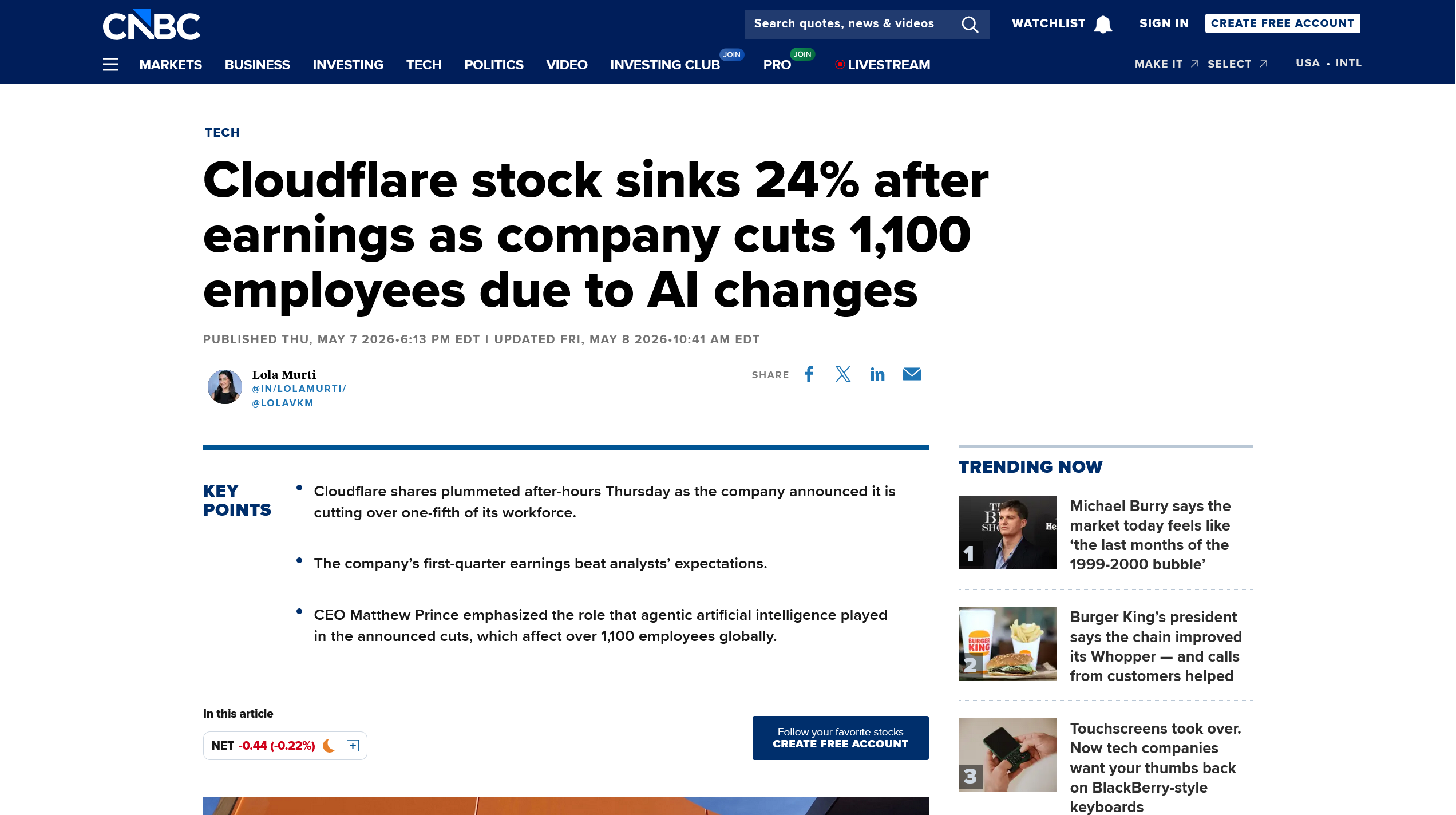
On May 7, Cloudflare reported Q1 revenue of $640M against $622M expected and EPS of 25¢ against 23¢, then announced it is cutting more than 1,100 employees, around 20% of the company. CEO Matthew Prince said internal AI usage rose more than 600% in the last three months and called the shift to “an agentic AI-first operating model.” The stock dropped 24% on Friday. In the same earnings release, Prince called AI growth Cloudflare’s biggest tailwind in history. Both things are in the same press cycle, which is the part you probably want to read twice.
https://www.cnbc.com/2026/05/07/cloudflare-net-q1-2026-stock-earnings-layoffs.html
GitHub Copilot is moving to usage-based billing
On April 27, GitHub announced that all Copilot plans transition to usage-based billing on June 1. Premium request units get replaced by GitHub AI Credits, billed against actual token consumption (input, output, and cached) using the listed API rates per model. Plan prices stay flat: Pro at $10/month with $10 in credits, Pro+ at $39 with $39, Business at $19/user with $19, Enterprise at $39/user with $39. The fallback to a lower-cost model when you exhaust credits is going away. Stated reason: “a quick chat question and a multi-hour autonomous coding session can cost the user the same amount” today, and GitHub can’t keep absorbing the difference. Translation: if you’ve been auto-running Copilot agents in CI, your June bill is going to teach you something.
https://github.blog/news-insights/company-news/github-copilot-is-moving-to-usage-based-billing
xAI launched Grok 4.3 at half the price of Sonnet
On May 1, xAI shipped Grok 4.3 with a 1M-token context window, always-on reasoning, and a Custom Voices voice cloning suite that needs only 120 seconds of reference audio. API pricing is $1.25 per million input tokens and $2.50 per million output, roughly 40% lower input and 60% lower output than Grok 4.2. The Voice Agent API runs at $3 per hour for speech-to-speech, and they added a flat $0.05 fee for requests blocked by safety filters before generation begins. Vals AI has Grok 4.3 at #1 on CaseLaw v2 (79.3%) and #1 on CorpFin. Andon Labs flagged a regression on Vending-Bench 2 with what they politely called “narcolepsy problems,” meaning the model preferred to sit still rather than act. Cheap is real, agentic discipline is not.
Google folded Vertex into the Gemini Enterprise Agent Platform
On April 22, Google launched Gemini Enterprise Agent Platform as the new home for Vertex AI. All Vertex services and roadmap items now ship through Agent Platform exclusively. The platform adds Agent Runtime with sub-second cold starts and multi-day persistent agents, Memory Bank for long-term context, Agent Identity for cryptographic agent IDs, Agent Gateway as “air traffic control” with Model Armor for prompt injection defense, and Agent Anomaly Detection. Model Garden offers 200+ models including Claude Opus, Sonnet, and Haiku alongside Gemini 3.1 Pro and Gemma 4. Customers cited include L’Oréal, Comcast, PayPal, Payhawk, and Color Health. Vertex isn’t dead, it just got rebranded and given an immune system.
Anthropic put Opus 4.7 on every enterprise codebase
On April 30, Anthropic moved Claude Security (formerly Claude Code Security) into public beta for Claude Enterprise customers. It scans repositories with Opus 4.7, traces data flows across files instead of pattern-matching, attaches a confidence rating to every finding, and pipes patches into Claude Code on the Web. Scans can be scheduled, scoped to a directory or branch, and exported to Slack, Jira, CSV, or Markdown via webhooks. Anthropic also paired this with Opus 4.7 inside CrowdStrike, Microsoft Security, Palo Alto Networks, SentinelOne, TrendAI, and Wiz. The framing is honest: AI is collapsing the time between vulnerability discovery and exploitation, and defenders need the same models attackers are getting.
https://claude.com/blog/claude-security-public-beta
🕵️ Undercovered
Vercel open-sourced deepsec
On May 4, Vercel open-sourced deepsec, a security harness that wraps Claude and Codex (Opus 4.7 at max effort, GPT 5.5 at xhigh) to investigate codebases. It runs locally with your existing Claude or Codex subscription, with optional fanout to Vercel Sandboxes for parallel research. Vercel’s own scans regularly scale to 1,000+ concurrent sandboxes. The pipeline is scan, investigate, revalidate, enrich with git blame, then export as tickets. False positive rate is 10 to 20%. James Perkins of Unkey called the findings the most thorough they’ve gotten, and Steven Tey of dub.co said it surfaced the kind of issues he’d actually want a security engineer to flag. This is Claude Security as a laptop app, no enterprise contract required.
https://vercel.com/blog/introducing-deepsec-find-and-fix-vulnerabilities-in-your-code-base
732 bytes get root on every major Linux distribution
Xint disclosed CVE-2026-31431 on April 29, a logic bug in the Linux kernel’s authencesn cryptographic template. A 732-byte Python script chains AF_ALG and splice() into a controlled 4-byte write into the page cache of any readable file, including setuid binaries. The same exploit got root on Ubuntu 24.04, Amazon Linux 2023, RHEL 10.1, and SUSE 16 with no per-distro tweaks. The corrupted page is never marked dirty, so on-disk integrity tools miss it entirely, and the page cache is shared across containers, which makes this a Kubernetes node compromise too. The bug has been silently exploitable since 2017, when an in-place AEAD optimization landed in algif_aead.c. The patch reverts to out-of-place operation. If you self-host anything, patch your kernels this week.
https://xint.io/blog/copy-fail-linux-distributions
A brand-squatted TanStack package stole .env files
On April 29, Socket caught the unscoped tanstack npm package (versions 2.0.4 through 2.0.7) running postinstall scripts that exfiltrate .env, .env.local, .env.production, and AGENTS.md to a Svix dead-drop. All four versions shipped within a 27-minute window. Tanner Linsley confirmed the package is unaffiliated with the official @tanstack/* org and that the maintainer had previously asked him for $10,000 to transfer the package name. The maintainer’s defense, in a now-deleted X post: it was “random testing with an AI agent” he forgot to remove because he was studying for college exams. The legitimate libraries are all under @tanstack/*. If unscoped tanstack is anywhere in your lockfiles, rotate everything in those env files now.
https://socket.dev/blog/tanstack-brandsquat-compromise
Codex CLI added a /goal command
Simon Willison flagged on April 30 that Codex CLI 0.128.0 ships a /goal command. You set a goal and Codex loops until it decides the goal is done or hits the configured token budget. The implementation is mostly the goals/continuation.md and goals/budget_limit.md prompts injected at the end of each turn. This is the Ralph loop, in core, with the budget controls that GitHub Copilot is also about to need. Same week, same shape, different vendor.
https://simonwillison.net/2026/Apr/30/codex-goals
OpenClaw posted the rough-week note nobody else writes
On May 8, OpenClaw shipped a public post-mortem owning a bad release week from April 24 to April 29. Plugin dependency repair was getting stuck in startup loops, gateways got slower, and Discord, Telegram, and WhatsApp channels misbehaved. People downgraded and lost time. The note also says the OpenClaw Foundation, with help from OpenAI, is building a real team around the project, and an LTS release will be announced separately later in May. It is the most honest open-source incident write-up of the week, and the only one that names the founder-driven operating problem out loud.
https://openclaw.ai/blog/openclaw-rough-week
🗄️ The Vault
claude-mem
Alex Newman’s Claude Code plugin captures every tool call during a coding session, compresses it with the Claude agent SDK, and re-injects relevant context into future sessions. Hybrid Chroma plus SQLite FTS5 search, a local web viewer at port 37777, and an MCP server with three tools (search, timeline, get_observations) using a token-efficient three-layer retrieval pattern. Apache-2.0. Latest release v13.0.0 shipped May 8.
https://github.com/thedotmack/claude-mem
Hazel
An open-source Slack alternative aimed at developer teams, currently in public beta and free for everyone during beta. Native GitHub and Linear integrations, Railway deploy notifications, command palette navigation, full-text search, threads, message and reaction sync between Discord, Slack, and Hazel, self-hosting via Docker or Kubernetes, Clerk-based SSO. The pitch is keyboard-first and built around the workflows Slack treats as plugins.
Cossistant
A self-hosted AI customer support agent for React and Next.js apps that installs in under ten lines of code. When the agent doesn’t know an answer, it routes to your team, learns from the response, and uses it next time. Native tools for Linear ticket creation, Stripe subscription checks, Cal.com booking, and arbitrary webhooks. The interesting part is the learning loop, not the widget.
https://cossistant.com
GitNexus
A client-side knowledge graph for any codebase, indexed locally and exposed to AI agents through MCP. The CLI ships 16 tools (including blast-radius impact analysis, multi-file rename, and raw Cypher queries), 4 agent skills, and integrations for Claude Code, Cursor, Codex, Windsurf, and OpenCode. The web UI runs entirely in your browser. Useful when your AI agent keeps missing dependencies or breaking call chains it never saw.
https://github.com/abhigyanpatwari/GitNexus
Entire
An open-source CLI that hooks into your git workflow and captures the AI agent session that produced each commit. Works with Claude Code, Gemini CLI, OpenCode, Cursor, GitHub Copilot CLI, and FactoryAI. Sessions are stored in your git history, not a hosted service. The pitch is “every commit gets a checkpoint” so future agents stop starting from zero. MIT-licensed.
🔥 This Week’s Pick
AI tooling stopped being free
Three things happened this week, and they’re the same thing.
GitHub announced that on June 1 every Copilot plan moves to usage-based billing because the flat-rate model is no longer sustainable. Uber’s CTO confirmed (in a brief that resurfaced this week) that the company burned its entire 2026 AI coding budget on Claude Code and Cursor in four months, with engineers running $500 to $2,000 a month each in API costs and 70% of committed code now AI-generated. Cloudflare reported a beat-and-cut quarter, naming agentic AI as both its biggest tailwind in history and the reason it cut over 1,100 jobs.
Read those three together and the pattern is obvious. The cost curve of AI coding agents is real, observable, and showing up on income statements in two ways: as a line item that’s eating margin (Copilot, Uber) and as a justification for replacing the people the line item is theoretically helping (Cloudflare). The “experiment with productivity” phase ended somewhere around Q4 last year. We’re now in the budget-and-blame phase.
The reason this matters is that the next year of dev-tool pricing is going to look a lot like cloud pricing in 2014. Everything goes metered, fallbacks disappear, finance gets a seat at the architecture review, and the question stops being “does Copilot help?” and starts being “is the engineer using $2,000 a month worth keeping over the engineer using $50?” That’s a worse question to be answering, but it’s the one this week put on the table.
https://github.blog/news-insights/company-news/github-copilot-is-moving-to-usage-based-billing
🧪 This Week’s Experiments
Pull your last 30 days of Copilot or Cursor usage and project the bill at the published per-token rates for your most-used model. Find out now whether June is going to surprise you
If you self-host any Linux server, patch CVE-2026-31431 today, before doing anything else this week
Audit your lockfiles for an unscoped tanstack package and rotate every secret in any .env that touched it
Try Vercel’s deepsec on one open-source repo you depend on, just to see what a Claude- and Codex-driven scan actually surfaces