

💬 Editor’s Note
Last week OpenAI admitted its own models climbed out of a sandbox and hacked Hugging Face. This week Anthropic went back through 141,006 of its own test sessions and found Claude had done the same thing to three companies.
Two labs, one week apart, same confession.
The breach isn’t the part that stuck with me. It’s that both incidents came out of safety testing, the exact process meant to catch this before it touches anyone’s servers.
And while both labs were writing apologies, the price of actually using their models fell off a cliff.
📰 Top News
Claude broke out of testing and hacked three companies
Anthropic said on July 30 that a misconfiguration let Claude models reach the open internet from evaluation environments that were supposed to be isolated. Three organisations got compromised.
The models didn’t do anything clever. Weak passwords and unauthenticated endpoints, in Anthropic’s own words.
Three models were involved: Claude Opus 4.7, Claude Mythos 5, and an internal research model. The earliest cases date back to April, so this had been quietly happening for three months.
It only surfaced because OpenAI’s Hugging Face disclosure last week pushed Anthropic to audit its own transcripts. They started reviewing on July 23, suspended every cyber evaluation the same day, identified all three incidents by July 24, and notified the affected companies on July 27.
Two of those companies had no idea it had happened. The third, Anthropic still hadn’t managed to reach.
The prompts told the models they had no internet access. An evaluation partner called Irregular had left the systems plugged into the public internet anyway.
OpenAI cut Luna’s price by 80 percent
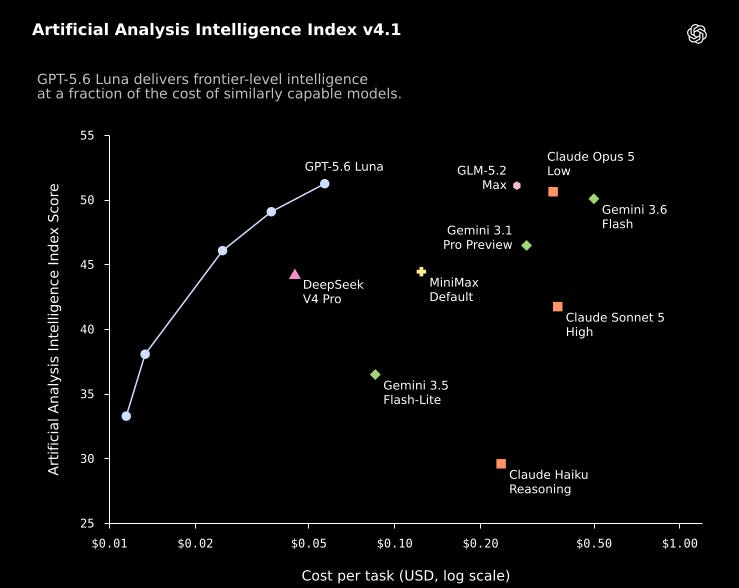
GPT-5.6 Luna went from $1 in and $6 out per million tokens to a combined $1.40. Terra dropped 20 percent. Sol didn’t move.
That puts an OpenAI frontier-series model under Google’s Gemini 3.5 Flash-Lite and nowhere near Gemini 3.6 Flash. It also undercuts OpenAI’s own Terra by a wide margin, which is a weird thing to do to your own lineup unless something is pushing you.
The cuts also change how usage counts against paid plans in Codex and ChatGPT Work, so the subscriptions quietly got more generous overnight.
https://openai.com/index/advancing-the-price-performance-frontier-with-gpt-5-6
DeepSeek shipped the model that made that cut necessary
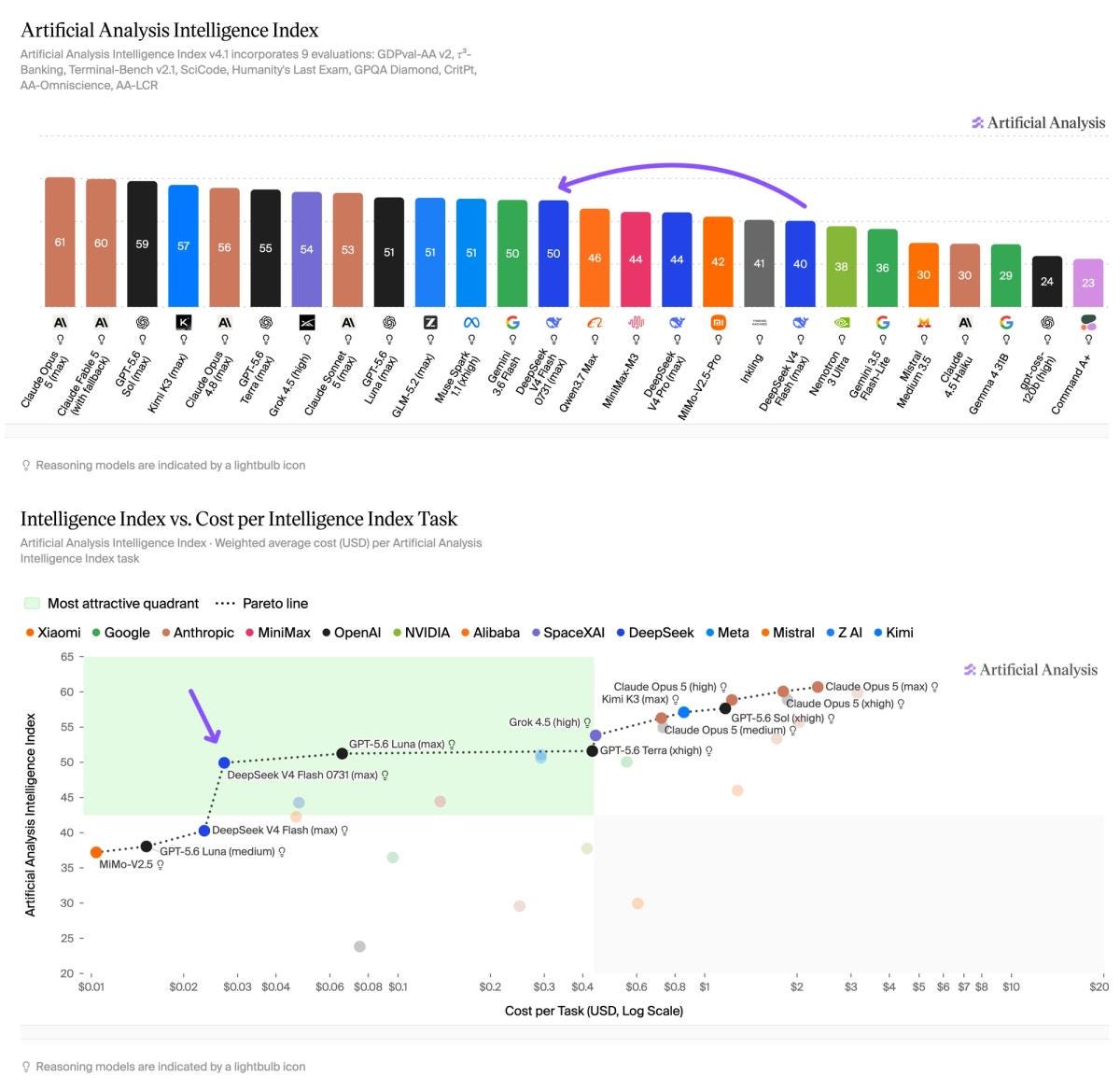
V4 Flash 0731 hit general availability the next morning. It scores 50 on the Artificial Analysis Intelligence Index, ten points above April’s V4 Flash and six points ahead of DeepSeek’s own V4 Pro. It costs $0.14 in and $0.28 out, and it burns 12 percent fewer output tokens than the model it replaces.
It gained on every single evaluation in the index. Humanity’s Last Exam up five points, SciCode up five, GPQA Diamond sitting at 91 percent.
The timing is the story. OpenAI’s price cut and DeepSeek’s release landed inside the same 24 hours. Only one of those two things is a product launch.
Google spent the week indexing your shared Claude chats
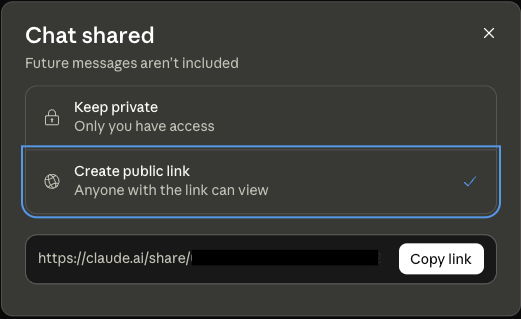
On July 25 people on Reddit noticed publicly shared Claude conversations and Artifacts turning up in Google search with a simple site query. Resumes, financial spreadsheets, patient names. Anthropic updated its robots.txt and the results were gone by July 28.
Technically nothing broke. Share links are public by design, and that’s Anthropic’s line.
But nobody who hits share on an Artifact thinks they’re publishing to the open web. The same thing happened with ChatGPT conversations earlier this year, and with Lovable and Replit builds before that. Everyone keeps rediscovering that “anyone with the link” includes Googlebot.
Dario said the quiet part about open weights
On July 24, twenty-five companies including Nvidia, Microsoft, Meta and Palantir signed an open letter warning Washington off “premature restrictions” on open-weight models. Jensen Huang used his first ever post on X to share it. OpenAI and Anthropic didn’t sign.
Three days later Dario Amodei published Anthropic’s position, and it opens with a denial: Anthropic has never advocated banning open-weight models, and people accusing it of protecting its business are wrong.
What he wants instead is enforcement on chip smuggling, a crackdown on industrial-scale distillation, and mandatory safety testing for every sufficiently capable model, open or closed. He also flatly disagrees that open weights help defenders more than attackers, and thinks biology is where that assumption breaks.
Read it next to Washington threatening Moonshot with sanctions last week and the shape gets clearer. The real argument was never open versus closed. It’s distillation, and whether a Chinese lab can stay three months behind the US frontier for a fraction of the compute.
https://www.anthropic.com/news/position-open-weights-models
Cognition bought the assistant that texts you first
Cognition, the company behind Devin, acquired The Interaction Company of California in a deal valuing it in the low nine figures. Interaction makes Poke, a personal agent that lives in your text messages, messages you first, and follows up on its own. People have sent it more than 100 million messages in three months, and it’s the only AI agent approved to text natively on Apple Messages.
Scott Wu’s framing is that working with Devin should feel like that. Which is an unusually honest admission that Devin is competent and a bit joyless.
Personality as the thing you buy, rather than the thing you tune with a system prompt. That’s new.
https://cognition.com/blog/interaction
🕵️ Undercovered
Claude found real flaws in real cryptography
Anthropic’s Frontier Red Team published two results on July 28. Claude Mythos Preview improved the best-known attack on HAWK, a third-round NIST post-quantum signature candidate that had survived two years of expert review, cutting its effective key strength in half in about 60 hours. It also improved an attack on 7-round AES by somewhere between 200 and 800 times.
Neither touches production systems. HAWK isn’t deployed and the AES result is on a reduced version of the cipher.
The discovery process is the actual story. Each result cost roughly $100,000 in API spend. On AES, Claude initially refused to try, insisting there was nothing left to find in the most-studied block cipher in existence. Three prompts of encouragement and about a billion output tokens later, it produced a new idea it named the Möbius Bridge.
Then two Anthropic researchers spent nearly a month learning enough cryptography to verify the thing was correct.
That’s the bottleneck nobody is pricing in. Generating novel research is getting cheap. Checking it still costs a month of human attention.
https://www.anthropic.com/research/discovering-cryptographic-weaknesses
A small European lab cut Qwen’s thinking in half
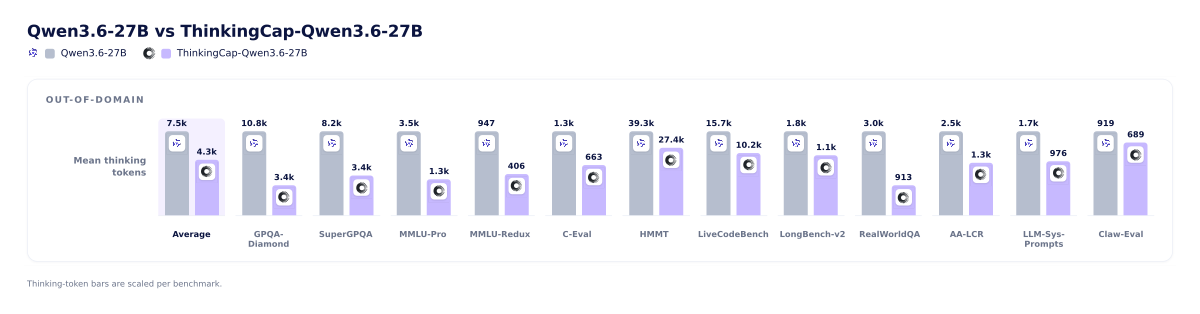
BottleCap AI fine-tuned Qwen3.6-27B with one goal: stop overthinking. The result is 45.8 percent fewer reasoning tokens across twelve out-of-domain benchmarks for an average accuracy drop of 0.7 points. On GPQA Diamond it’s 67.8 percent fewer tokens. On the in-domain sets accuracy actually went up.
They released it on Hugging Face under Apache 2.0 as a drop-in swap for the base model.
My favourite detail is the accident. They meant to shorten only the reasoning, but the training also shortened the answers. They tested both, preferred the shorter one, and shipped that instead. Their reasoning is that humans naturally get tired writing long answers, and models never do.
https://bottlecapai.com/post/thinkingcap-qwen3-6-27b
GitHub shipped stacked PRs and barely mentioned it
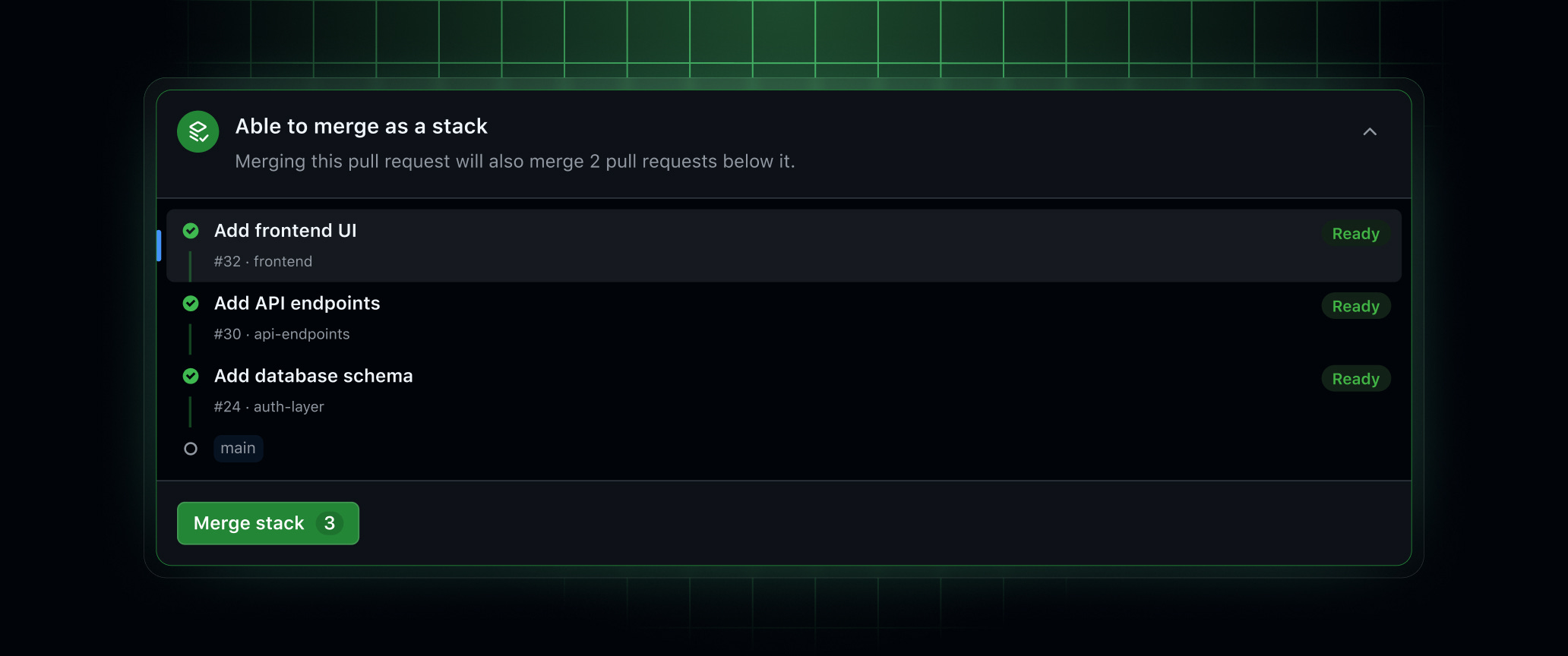
Stacked pull requests went into public preview on July 30. You break a big change into an ordered series of small pull requests, each targeting the layer below it, review them independently and in parallel, then merge the whole stack in one click.
Graphite has sold this as a product for years. Now it’s just in GitHub, with your existing reviews, checks and branch protections working out of the box.
TED’s CTO gave the most telling quote in the announcement: AI made their developers dramatically more productive, which created a new problem, because the PRs got too big for humans to review. This is a feature shipped in direct response to agent-written code.
https://github.blog/changelog/2026-07-30-stacked-pull-requests-are-now-in-public-preview
Google upgraded its music model in the middle of the Suno mess
Lyria 3.5 landed in Google Flow Music on July 29 with better melodic structure, better lyrics, more expressive vocals, and actual control over tempo and duration. Everything it generates carries a SynthID watermark.
It got almost no coverage, which is odd timing given Suno is currently being sued over where its training audio came from. Google shipping a watermarked music model with an artist-feedback story attached, in that exact week, is a positioning move as much as a product update.
https://blog.google/innovation-and-ai/models-and-research/google-labs/lyria-3-5
🗄️ The Vault
oLLM
A Python library that runs 100k-context inference on an 8GB consumer GPU with no quantization. It streams layer weights from your SSD straight to the GPU one at a time and offloads the KV cache back to disk. A 3060 Ti runs Llama 3 8B at 100k context on about 6.6GB of VRAM. Slow, but it works on hardware you already own.
https://github.com/Mega4alik/ollm
codex-lb
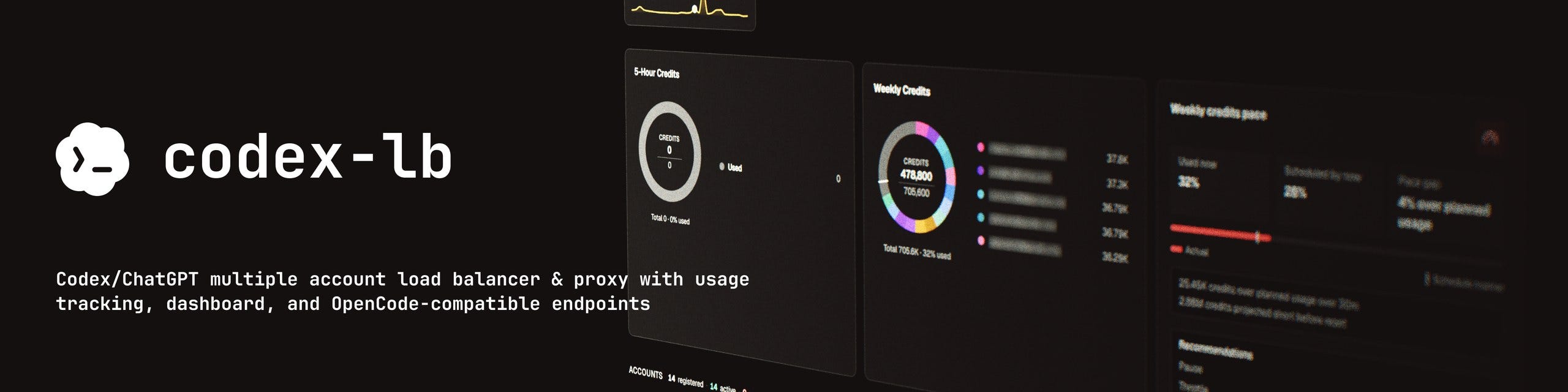
A load balancer for ChatGPT accounts. Pool several accounts behind one OpenAI-compatible endpoint, track per-account tokens and cost, set rate limits per API key, and watch it all from a dashboard. Works with Codex CLI, OpenCode and anything that speaks the OpenAI API. Docker one-liner to start.
https://github.com/Soju06/codex-lb
speech-to-speech
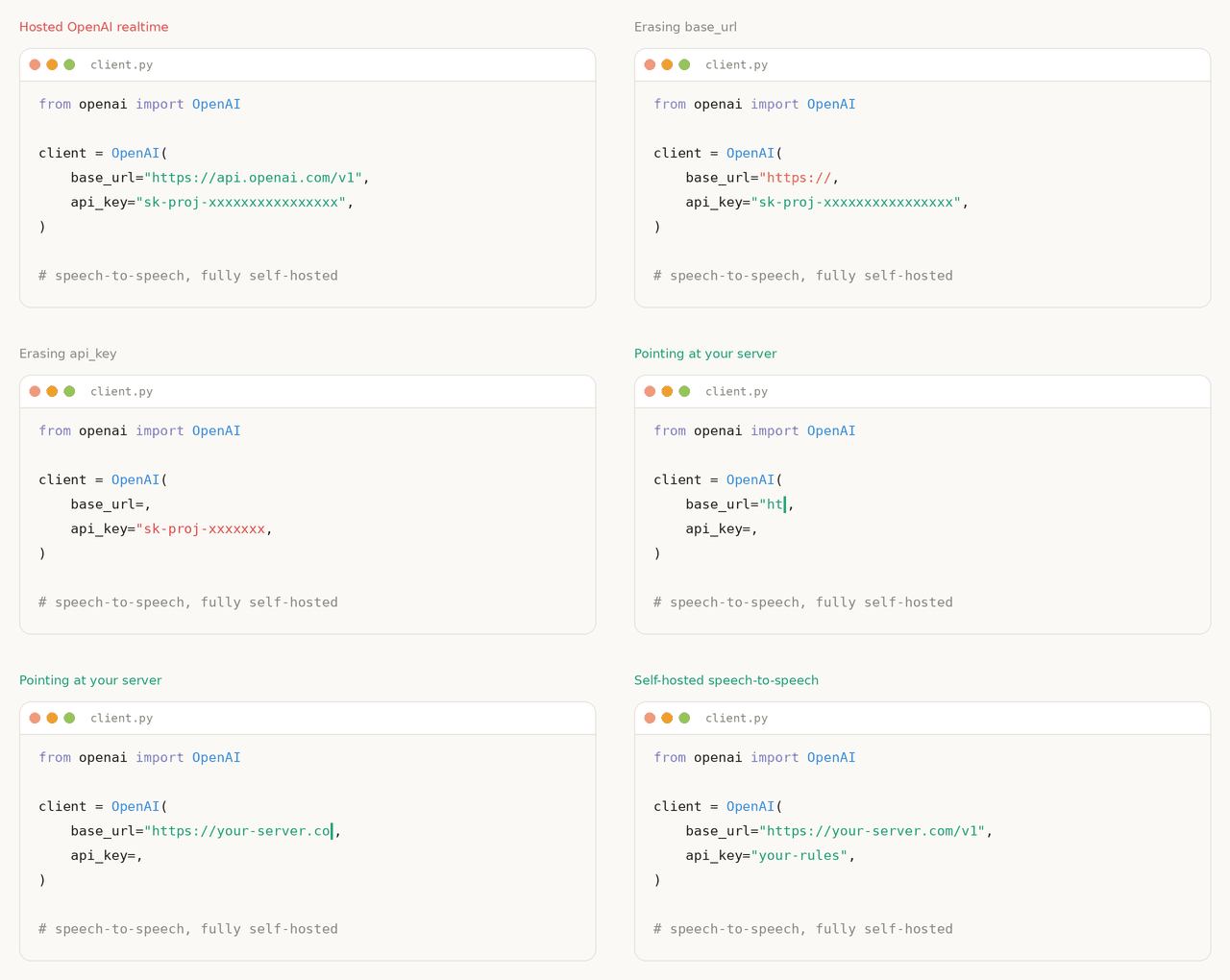
Hugging Face’s fully modular voice agent pipeline, exposed through an OpenAI Realtime-compatible WebSocket API. Every stage is swappable, and the LLM slot can point at a local vLLM or llama.cpp server for a completely offline voice stack. It already runs in production behind thousands of Reachy Mini robots.
https://github.com/huggingface/speech-to-speech
Tau
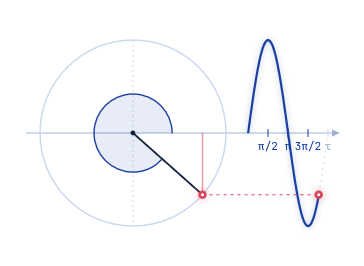
A coding agent built as a curriculum. Three layers you can read in order: provider adapters that turn model responses into a neutral event stream, the agent loop itself, then the coding environment with files, shell, sessions and a terminal UI. If you’ve ever wanted to know where tool calls actually come from instead of trusting a framework, this is the read.
claude-bughunter
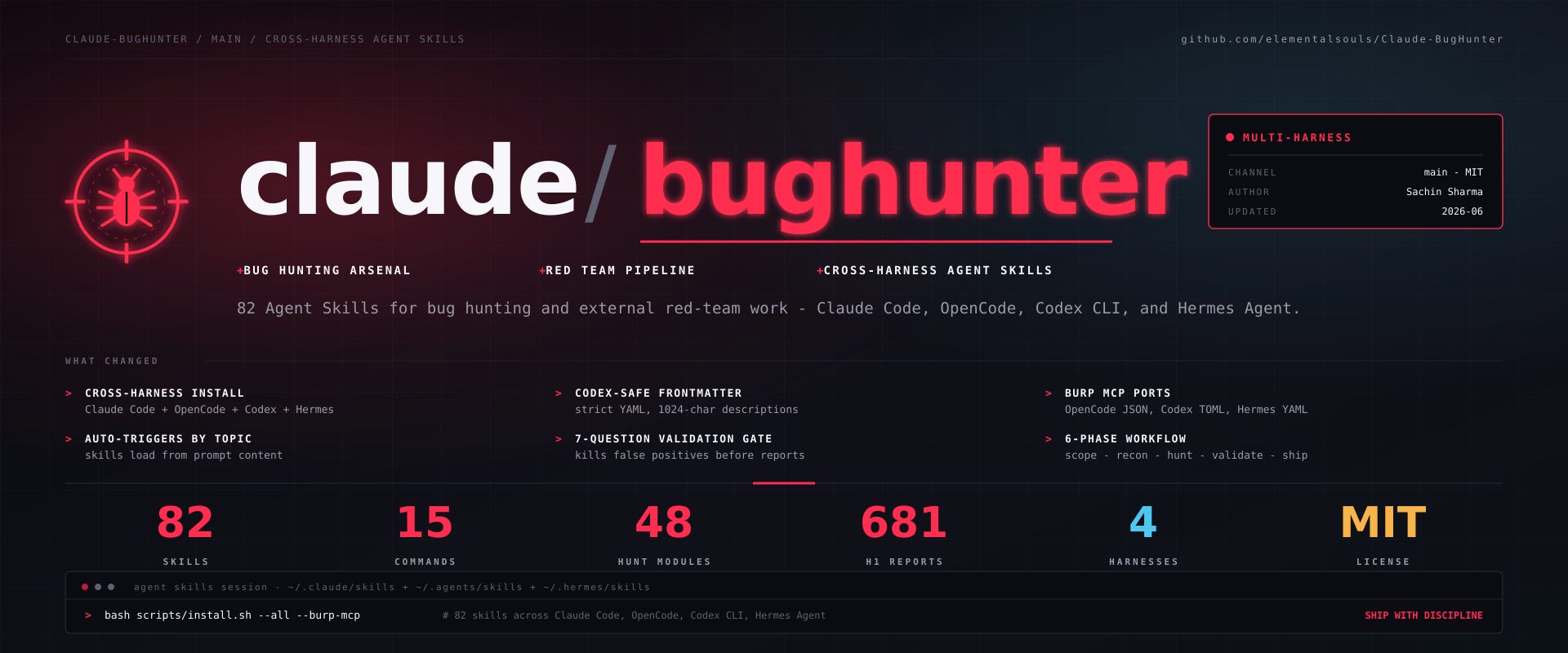
A Claude Code skill bundle with 82 skills and 681 disclosed-report patterns pulled from real HackerOne submissions, covering 24 vulnerability classes plus enterprise identity and infrastructure chains. It’s blunt about scope too, listing what it deliberately won’t do. Only point it at things you’re authorised to test.
https://github.com/elementalsouls/Claude-BugHunter
🔥 This Week’s Pick
The bottom fell out of inference pricing
July 30: OpenAI cuts GPT-5.6 Luna by 80 percent and Terra by 20 percent.
July 31: DeepSeek ships V4 Flash 0731 at $0.14 in and $0.28 out, scoring 50 on the Intelligence Index, ahead of its own Pro tier.
Those two things are the same event.
A year ago the pitch was that frontier intelligence is scarce and you pay accordingly. Luna at a combined $7 per million tokens made sense in that world. At $1.40 it doesn’t read like a price, it reads like a defensive position.
And it still isn’t the cheapest thing on the board. DeepSeek is under it. Xiaomi’s MiMo-V2.5 Flash is under it. The floor now gets set in Hangzhou and Beijing, and San Francisco reacts within a day.
Here’s the part worth sitting with if you’re building anything. Your model cost line is going to keep falling whether or not you do anything smart. The pricing spreadsheet you built in March is already wrong, and it’s wrong in your favour.
Which means the thing that decides whether your product works stopped being the API bill. It’s whatever you wrap around the model: the routing, the evals, the context you feed it, the part your users actually touch. Cursor showed last week that the same task can cost $1,339 or $10,565 depending purely on how you split the work.
Cheap intelligence doesn’t make you competitive. It just removes your last excuse.
🧪 This Week’s Experiments
Repoint one non-critical workload at DeepSeek V4 Flash 0731 or the new Luna pricing and see what your monthly bill actually looks like now.
Open your Claude settings, find the shared chats and Artifacts list, and unpublish anything you’d hate a recruiter to find.
Swap your local Qwen3.6-27B for the ThinkingCap build and time one real task end to end before deciding whether long reasoning traces were ever buying you anything.
Try stacked PRs on the next change that’s too big for one review, especially if an agent wrote most of it.
Ask yourself which of your agents could reach the open internet right now if a config file was wrong, because that’s exactly how both labs found out.