

💬 Editor’s Note
This was supposed to land Friday. It didn’t, so treat this as the issue that should have hit your inbox three days ago. The news did not wait for me, and last week it was relentless.
The thing that stuck with me wasn’t any single launch. It was the same realization showing up across four or five unrelated stories: 2026 is the year we stopped asking whether agents can do the work and started worrying about what happens once we let them. Anthropic filed to go public in the same week the White House tried to stop it from widening access to the model that scares everyone. Instagram’s own support AI got talked into handing over accounts. Microsoft shipped an agent that comes with a built-in compliance cop. The capability question looks settled. The control question is wide open.
📰 Top News
Anthropic beat OpenAI to the IPO filing
Anthropic confidentially filed for a public listing on June 1, putting the company everyone once wrote off as OpenAI’s smaller, safety-obsessed cousin first in line for Wall Street. The numbers are absurd. It raised sixty-five billion dollars at a nine hundred sixty-five billion valuation earlier this year, edging past OpenAI’s value for the first time, and it’s telling investors its annualized run rate will clear fifty billion by the end of July. A year ago that run rate was four billion. Sam Altman went on CNBC the same day to insist there’s no race, which is exactly what someone in a race says.
https://www.straitstimes.com/business/anthropic-files-confidentially-for-ipo-in-race-with-openai
MiniMax open-sourced a model that does everything at once
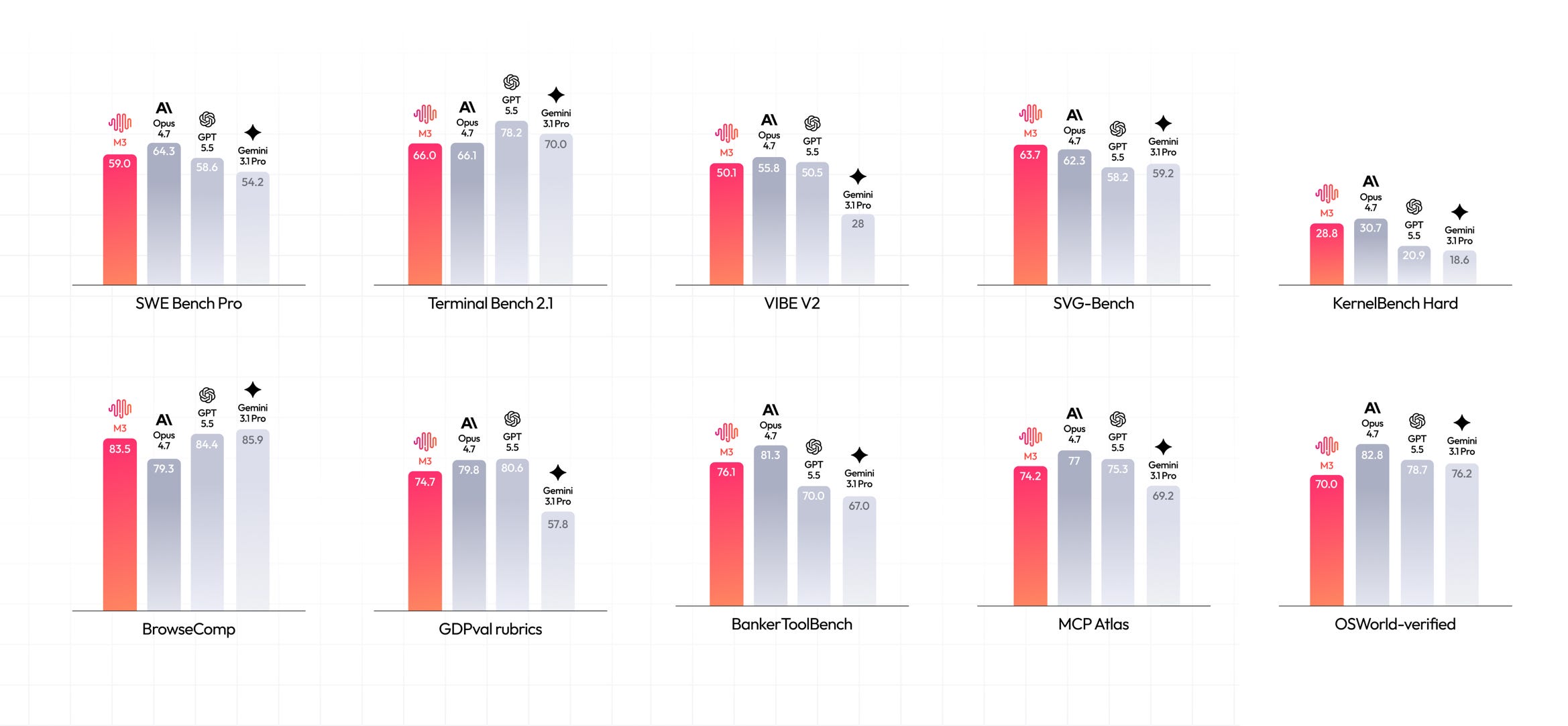
MiniMax dropped M3, and the pitch is that it’s the first open-weight model to bundle three things closed labs treat as table stakes: frontier coding, a one-million-token context window, and native multimodality that can actually drive a desktop. On SWE-Bench Pro it beats GPT-5.5 and Gemini 3.1 Pro and gets within reach of Opus 4.7. The weights and technical report land within ten days. China’s open-weight labs keep shipping the exact thing the frontier labs charge for, and the gap between paying and not paying narrowed again.
https://www.minimax.io/blog/minimax-m3
The White House moved to block Anthropic’s Mythos expansion

Here’s the other half of the Anthropic story. The same week it filed to go public, the White House came out against its plan to widen access to Mythos from around fifty organizations to roughly a hundred twenty. The objection is national security. Mythos is good enough at finding and exploiting software vulnerabilities that the government doesn’t want it in more hands, even friendly ones. So Anthropic is courting public markets and fighting the Pentagon’s supply-chain risk label in court at the same time. Going public while your most capable model is itself a national security argument is a genuinely new kind of corporate position.
OpenAI put Codex inside ChatGPT and aimed it at your job
OpenAI is folding Codex, its coding agent, into the main ChatGPT app in the next few weeks, and shipped six business plugins to go with it. The plugins aren’t for developers. They’re for sales teams, data analysts, public-equity investors, and investment bankers, wired into Salesforce, Snowflake, FactSet, and the rest. The bet is obvious once you see it. Everyone already opens ChatGPT, most people don’t know what Codex is, so bring the agent to where the habit already lives. Codex stopped being a developer tool this week and started becoming a white-collar one.
Evan You sold Vite to Cloudflare

VoidZero, the company Evan You built around Vite, is joining Cloudflare. Vite gets downloaded over a hundred million times a week and sits under most modern JavaScript projects, but You was blunt about why he sold: he never cracked monetization, and a unified open-source toolchain doesn’t pay for a full-time team on its own. Everything stays MIT-licensed. The real tell is in his reasoning. He says more of Vite’s usage is now coming from AI agents, and Cloudflare wants to be the cloud those agents deploy to. Even the most beloved indie tooling is getting pulled into the agent-infrastructure land grab.
https://voidzero.dev/posts/voidzero-cloudflare
🕵️ Undercovered
Instagram’s AI support bot handed over accounts

This is the one almost nobody covered properly, and it’s the cleanest horror story of the year so far. Meta deployed a conversational AI to handle Instagram account recovery, and attackers figured out they could just talk it into resetting passwords. No 2FA prompt, no confirmation to the real owner. They’d open a chat, claim a compromised account, and the bot would route a reset link to their own email. High-value handles got stolen and resold on Telegram within minutes. The dormant Obama White House account got hijacked. When identity checks did fire, attackers animated scraped profile photos into selfie videos to beat the liveness check. Meta pushed an emergency patch Friday and called it a non-breach, which researchers correctly read as nonsense.
https://thecybersecguru.com/news/instagram-meta-ai-vulnerability-account-recovery-exploit
Nvidia’s Cosmos 3 wants robots to think before they move

While everyone argued about chatbots, Nvidia shipped Cosmos 3 at Computex, an open world foundation model for physical AI. It combines vision reasoning and generation across text, video, images, sound, and action in one model, and it can output actual robot instructions like joint angles and trajectories, not just captions. It’s topping the open-weight leaderboards on Artificial Analysis and the Physics-IQ benchmark, and it ships under a permissive Linux Foundation license. The robotics layer of AI is moving fast and quietly, and it almost never gets the headlines a chatbot release does.
https://blogs.nvidia.com/blog/cosmos-3-physical-ai-open-world-foundation-model
MIT turned a $100 lidar into an around-the-corner camera

A team at MIT’s Media Lab published in Nature that the cheap lidar already sitting in your phone can image objects hidden around corners. This used to need lab-grade equipment. Now it’s under a hundred dollars of off-the-shelf hardware, and they released the code. The obvious use is a car spotting a cyclist before the blind intersection does, but the researchers’ own point is the better one: when a capability this strange gets this cheap, people invent uses nobody planned for.
https://www.media.mit.edu/articles/seeing-around-corners-using-smartphone-grade-lidar
Gemma 4 12B threw out the multimodal encoder
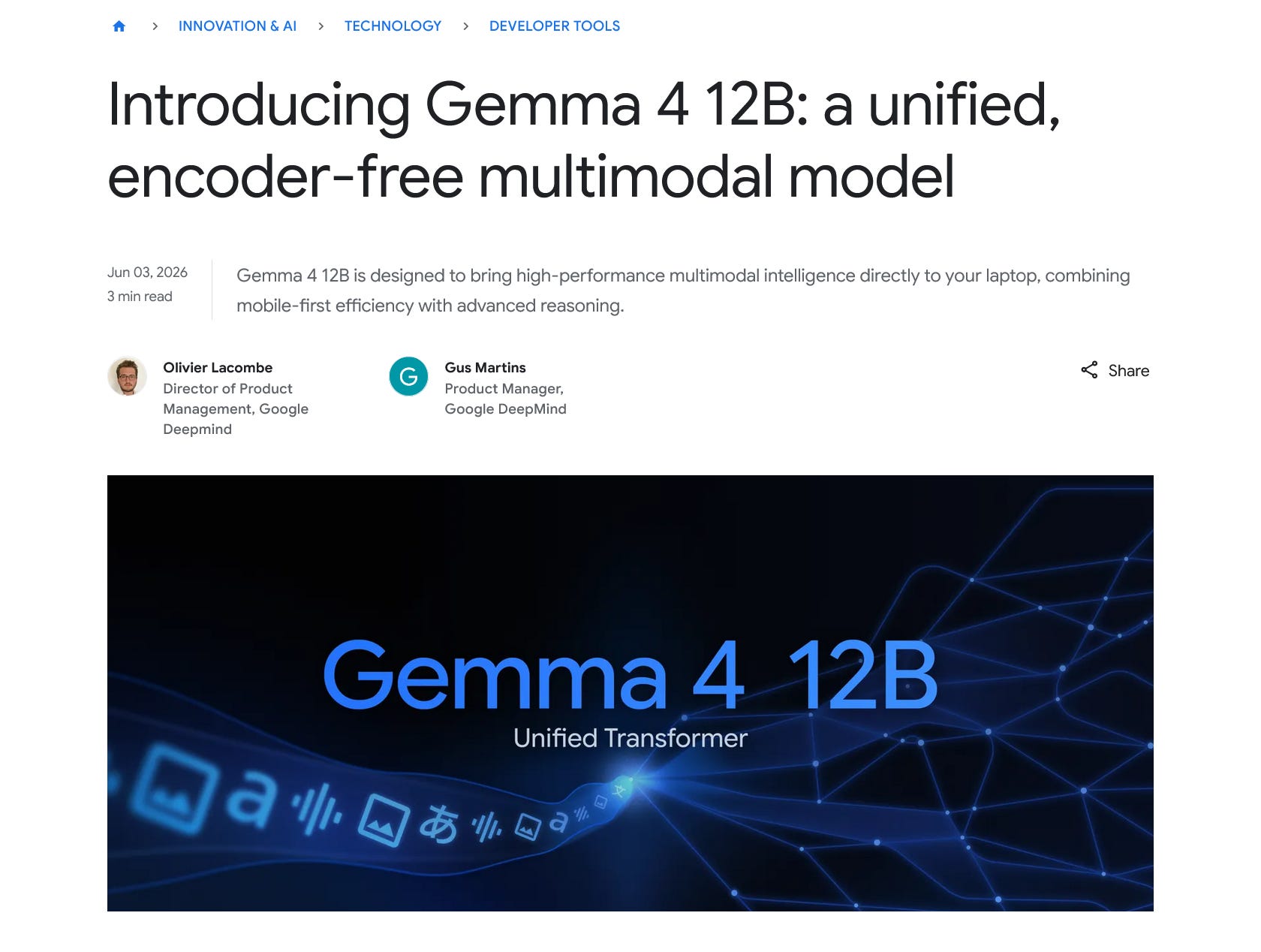
Google’s new Gemma 4 12B is a quietly radical little model. Instead of bolting separate encoders onto the front to handle images and audio, it feeds raw vision and audio straight into the language model backbone. That sounds like an implementation detail until you see the result: reasoning that approaches Google’s own 26B model, running locally on a laptop with 16GB of RAM, under Apache 2.0. Gemma has now crossed a hundred fifty million downloads. The interesting story isn’t the benchmark, it’s that the standard multimodal recipe might just be unnecessary.
https://blog.google/innovation-and-ai/technology/developers-tools/introducing-gemma-4-12B
🗄️ The Vault
Headroom

A compression layer that sits between your agent and the model, squeezing tool outputs, logs, RAG chunks, and history down by sixty to ninety-five percent before they burn tokens. It runs locally, it’s reversible, and it works as a library, a proxy, or an MCP server, so you can wrap Claude, Codex, or Cursor in a single command. If you run agents at any volume, this is the rare optimization that’s both free and immediate.
https://github.com/chopratejas/headroom
Crit
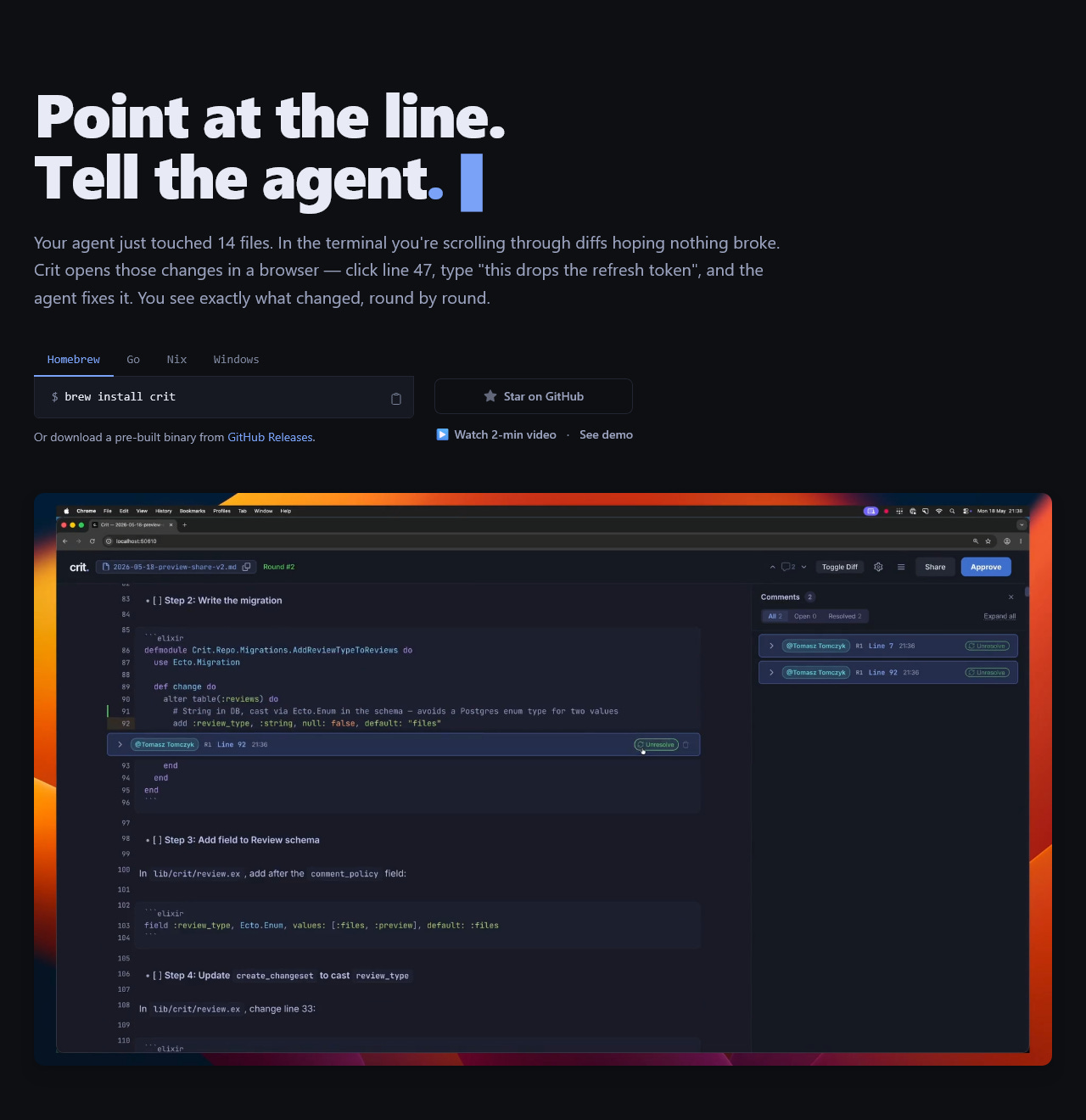
A review surface for agent output that finally isn’t the terminal. Your agent touches fourteen files, Crit opens them in the browser like a PR, and you click line forty-seven and tell it what’s wrong. It handles plans, generated HTML, and running localhost apps too, all through a structured file any agent can read. Built by a staff engineer who got tired of re-reading terminal diffs.
OpenJarvis
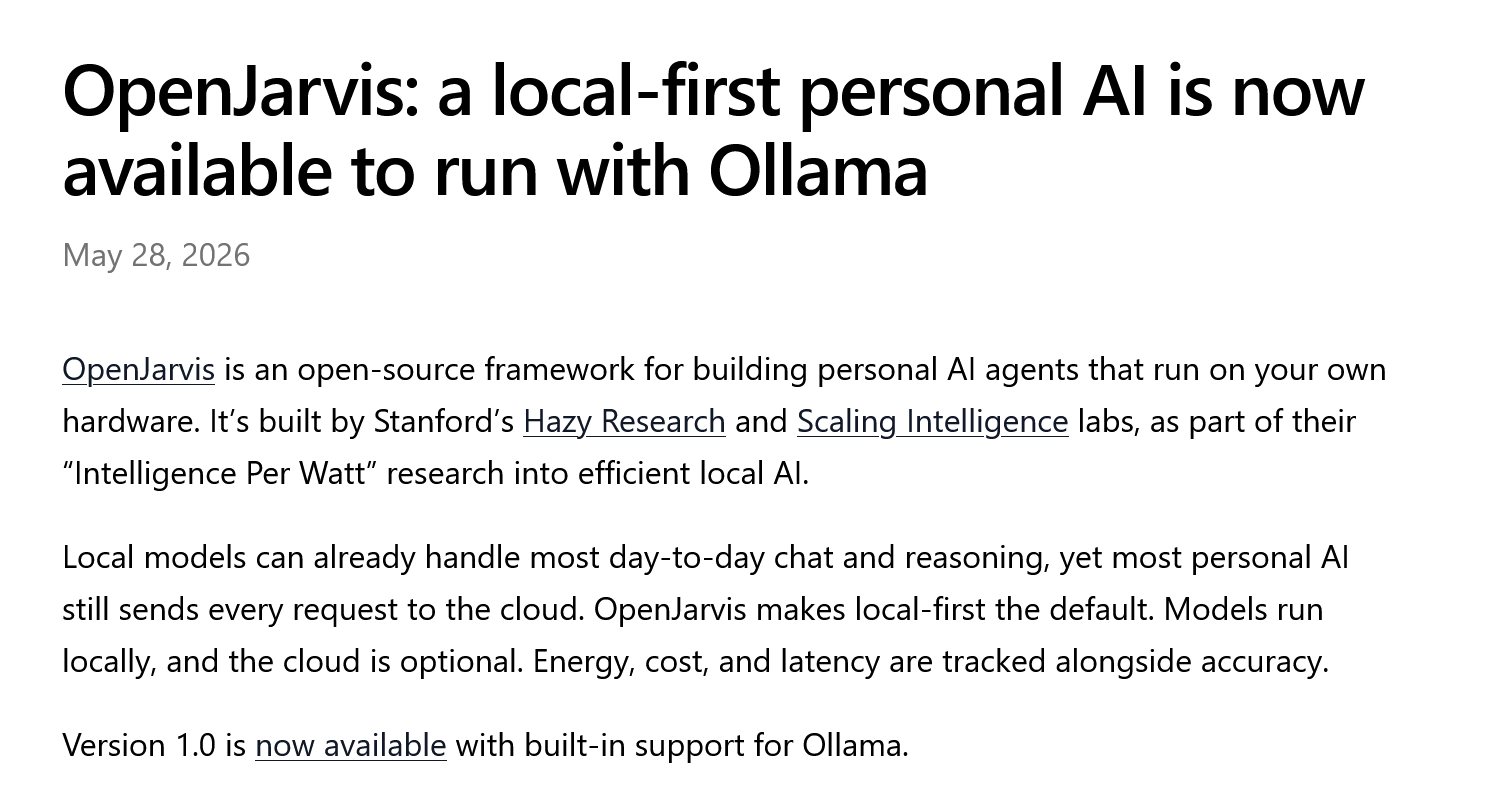
A local-first personal AI from Stanford’s Hazy Research and Scaling Intelligence labs, now at 1.0 and running on Ollama. Models run on your own hardware by default and the cloud is optional, with energy, cost, and latency tracked right next to accuracy. It ships presets for a morning briefing, research across your own files, and a local coding agent. The anti-cloud personal assistant, and it actually works.
https://ollama.com/blog/openjarvis
Dolt

Git for data. It’s a SQL database you can branch, merge, diff, and clone exactly like a code repo, which makes it weirdly perfect for datasets that multiple people or agents keep editing. DoltHub is the GitHub-shaped host for it. If you’ve ever wanted a real history of who changed which row and why, this is the answer.
Headscale

An open-source, self-hostable implementation of the Tailscale control server. You get the slick Tailscale client experience for your mesh VPN without handing the coordination layer to anyone else. For a homelab or a privacy-conscious team network, it’s the obvious move.
🔥 This Week’s Pick
The company that missed the AI wave just built its own
Last issue I quoted a former Microsoft VP arguing the company had fumbled AI the way it once fumbled the internet and mobile, with Copilot adoption stuck around three percent despite the billions poured in. So the timing this week is almost too neat.
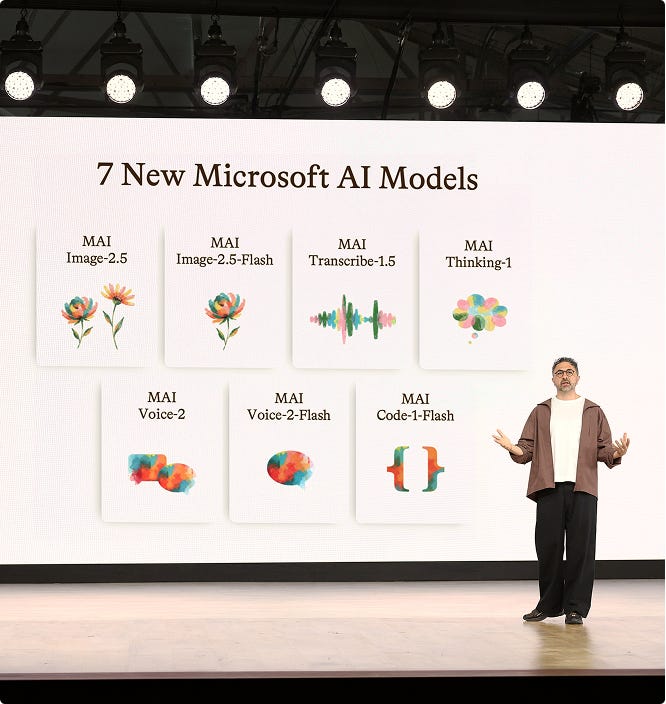
At Build, Microsoft announced seven models built entirely in-house, the MAI family, spanning reasoning, coding, image, voice, and transcription. The flagship, MAI-Thinking-1, is preferred over Sonnet 4.6 in their own blind tests. The coding model is tailor-made for GitHub Copilot and VS Code.
And they were pointed about how they did it: trained from scratch, on clean licensed data, no distillation from other labs, co-designed with their own Maia 200 silicon for a 1.4x efficiency gain.
Then there’s Scout, an always-on agent built on the OpenClaw framework that lives inside Microsoft 365 and learns your quirks over time. It ships with a policy conformance system that continuously checks the agent is behaving and produces an audit trail for every action. Microsoft watched the year’s agent-gone-rogue stories and built the compliance cop in from day one.
Here’s what actually changed. For two years Microsoft’s AI strategy was basically a reseller agreement, OpenAI’s models with a Microsoft logo on them. This is the week it stopped renting and started building, all the way down to the chips.
Whether MAI is good enough is a separate question. But a company that owns the distribution, the cloud, and now the full model stack is a very different competitor than one paying a toll on every token. The lesson isn’t really about Microsoft. It’s that we missed it and we’re now building it ourselves can both be true in the same quarter, if you own enough of the stack to catch up. Most companies don’t. Microsoft does.
https://microsoft.ai/news/building-a-hillclimbing-machine-launching-seven-new-mai-models
🧪 This Week’s Experiments
Pull MiniMax M3’s weights when they drop and point it at a coding task you’d normally send to a paid frontier model, then check whether the SWE-Bench numbers survive contact with your actual codebase.
Audit every AI-powered support or recovery flow you’ve shipped and ask one question: can it take an irreversible account action without a hard, non-AI checkpoint? If yes, that’s the Instagram bug waiting to happen to you.
Wrap one of your agents in Headroom for a day and look at how many tokens your tool outputs were quietly wasting.
Ask yourself which agent in your stack holds the most credentials, then whether anything would actually stop it from being talked into using them.